
Skateboarding as a driver of inclusive urban development
Jesper Kuipers, part of the Nine Yards team, wrote the essay 'Beyond concrete boxes: Skateboarding, Landscape Architecture, and Urban space'. In this article we look at the chapter 'place-making for and by skateboarders', in which Jesper explores the relationship between skateboarders, the urban environment and place-making.
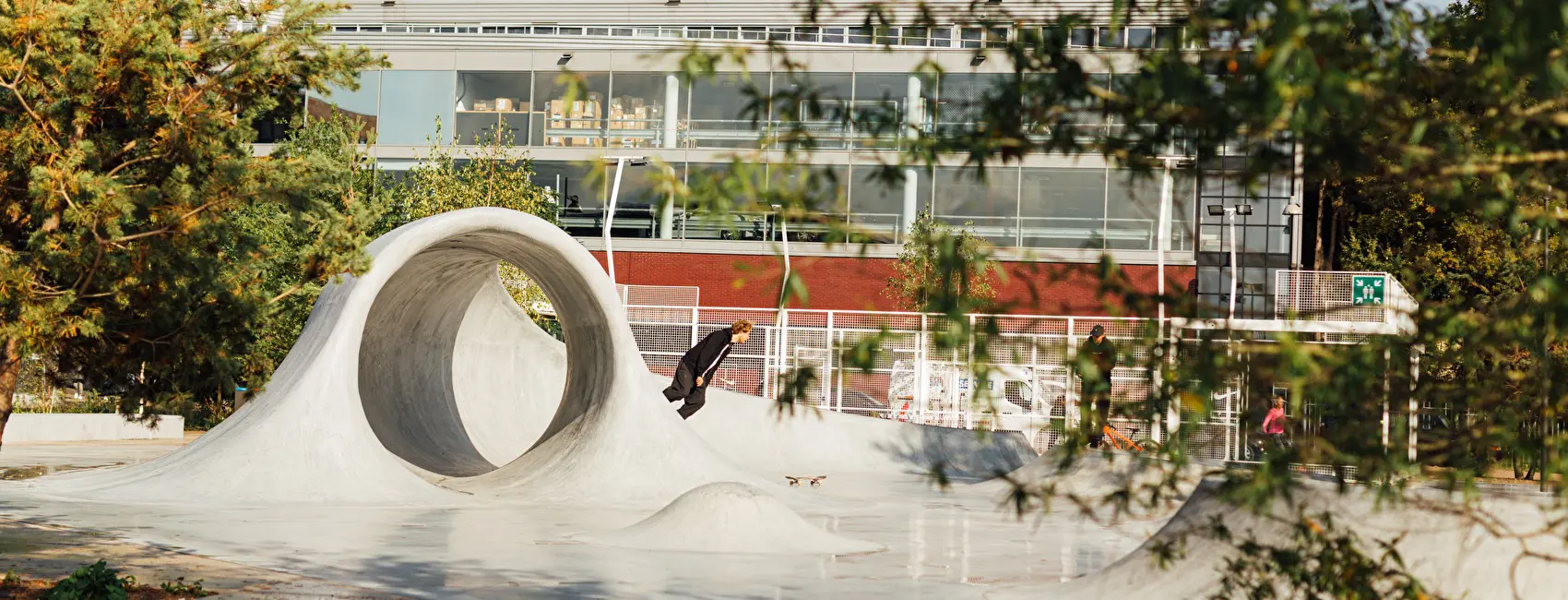
In the world of urban environments, skateboarding offers a different perspective that helps us understand the complexity of place-making. Long regarded as being on the fringes of urban planning, this subculture not only offers a fresh view of public spaces, but also contributes to a more inclusive and dynamic urban environment.
Place-making as a dynamic web
Places, as proposed by Massey's theory of relationality, are not static entities with a uniform identity, but collections of social relations and diverse identities. A city is a living organism, driven by the interaction of a wide range of actors, practices and agendas. Lehtovuori (in Beukeboom, 2023) emphasizes the versatility of urban space as the soul of a city, in which dynamism arises from the coexistence of contrasting elements.
Rewilding urban spaces
Glenney & Mull's (2018) concept of 'rewilding' public spaces offers a fresh perspective on urban planning. Instead of seeing public places as controlled environments, they argue for a more natural, interactive approach. This idea is echoed in the work of Glover et al. (2021), who stress that interaction and physical contact are essential for meaningful innovation. By rethinking urban spaces as zones for discovery and interaction, a city can breathe.
Breaking boundaries: skateparks as urban oases
In the world of skateboarding, we see parallels with this refreshing approach in the form of skateparks. Historically, skateparks were seen as fenced-off zones of gray concrete with limited opportunities for interaction. However, the concept of a "wild" skatepark, integrated into the urban environment, is beginning to take root. Examples such as Landhausplatz square in Innsbruck illustrate how skateparks merge with the surrounding architecture, blurring the boundaries between skateparks and public spaces.
Skateboarders as urban planners
The interaction between skateboarders and urban environments is not a one-way street. Skateboarders play an active role in place-making processes. Their creative appropriation of the built environment changes not only the physical structure of cities, but also how they are perceived. By reinterpreting urban architecture, skateboarders challenge established norms and transform everyday urban spaces into places full of new values.
Skateboarders as innovators
Skateboarders practice a 'soft' form of activism: through their presence in urban spaces, they constantly redefine the prevailing notions of their surroundings. This 'gentle activism', as described by Glover et al. (2021), focuses on inclusive place-making and negotiating urban life. Skateboarders promote alternative ways of valuing the urban environment, seeing the city as a canvas for creative expression and inclusive appropriation.
Skateboarding as a driving force for positive social innovation
The impact of skateboarding extends beyond the boundaries of recreation. Research (Baines et al., 2020) shows that skateparks help prevent crime by providing opportunities for physical activity, building relationships and strengthening social capital. Time and again, skateboarders prove that they not only preserve places of cultural importance to them, but also contribute to wider society through positive changes in urban dynamics.
Skateboarding as a catalyst for inclusive urban development
In an era in which urban planning is redefining itself, skateboarding offers a compelling perspective on how we approach public spaces. The 'rewilding' of urban areas, the reinterpretation of skateparks and the active activism of skateboarders illustrate the power of this subculture as a catalyst for inclusive urban development. It is time to see skateboarding as more than just a recreational activity; it is a force that makes the city live and evolve, with skateboarders acting as pioneers of an urban revolution.
