
How can governments facilitate urban sports? The municipal vision on Urban Sports.
Urban sports are an opportunity for municipalities to get young people moving and keep them moving. The big question is often how to facilitate these sports in the right way. In the handbook Urban Sports - how young athletes organize themselves and how municipalities can stimulate, support and facilitate that, Maxi Sellering has collected the experiences and insights from the project and from many other initiatives and experts across the country.
Maxi Sellering, urban sports expert
From 2018 to 2021, Maxi was project lead of NOC*NSF's innovation project 'Urban Sports Coalition' (USC), a collaboration between the KNGU, the KNWU and Sportbedrijf Arnhem. The project researched and tested how governments can facilitate urban sports, with the goal of getting young people moving and keeping them moving. Maxi now works as Head of International Developments and Relations at the Dutch foundation 3X3 Unites, where she focuses mainly on international projects that use 3X3 basketball to offer young people perspective and opportunities. She shares her knowledge with us.
Urban sports create opportunities for municipalities
Urban sports have grown rapidly and are seen by many municipalities as an opportunity to get young people moving and keep them moving. The big question is often how to facilitate these non-traditional sports in the right way. The classic approach of supporting clubs and promoting sport does not suit these sports. They run on freedom and a fluid way of organizing, with and by a community. They lose their organizing power when you force a traditional structure on them. Think of board meetings, appointing people in charge, taking minutes and so on.
These sports are about pushing your own limits, within a community and with shared values. It is more a lifestyle than a sport (music, video, socials, etc.). That is why it needs not just a sports venue, but room to grow. The beauty is that you can put everything into these sports: all your talents and everything you find difficult.
Urban sports are interesting for municipalities for several reasons:
- Urban sports are part of an important youth culture of today, and therefore a way to connect with young people.
- Urban sports encourage physical activity.
- Thanks to urban sports, public space is used in a different way, bringing physical activity to the heart of a municipality or region.
- Urban sports contribute to the livability of a city, because they generate buzz and stimulate entrepreneurship.
- They shape young people physically and mentally. Urban sports are about falling and getting back up, about pushing your own limits, but also about shared values.
- Finally, urban sports are diverse, which creates an opportunity for inclusivity.
The Urban way of working
Urban sports are organized differently, which requires municipalities to let go of frameworks and dare to embrace new ideas openly, together with the target group. That can take the form of broad permits, a different way of communicating, offering space to experiment, initiative funds, or designing public space differently. When facilitating urban sports, the most important thing is to do it together with the target group. Without ownership by the target group, locations go unused and the money and energy are wasted. Young people need to be involved.
This target group is often very open and approachable. The starting point is simply to have an open conversation and listen. That way you map out the athletes, the initiatives and suitable existing hardware. It helps to have a central point of contact within the municipality, because local governments and their way of working are far removed from the world of urban sports. Translation is often needed in both directions. Sufficient support is also very important. Don't just think about what is going on in a neighborhood and municipality. Create allies by sharing interesting content with urban athletes and letting them tell the story themselves. It is about smartly connecting all stakeholders, not only thinking in terms of suitable hardware, and looking together at where lasting activation, with and by the community, is possible. That is how you reach that large group of young people and offer them perspective.
Urban sports as an advisor on public space planning
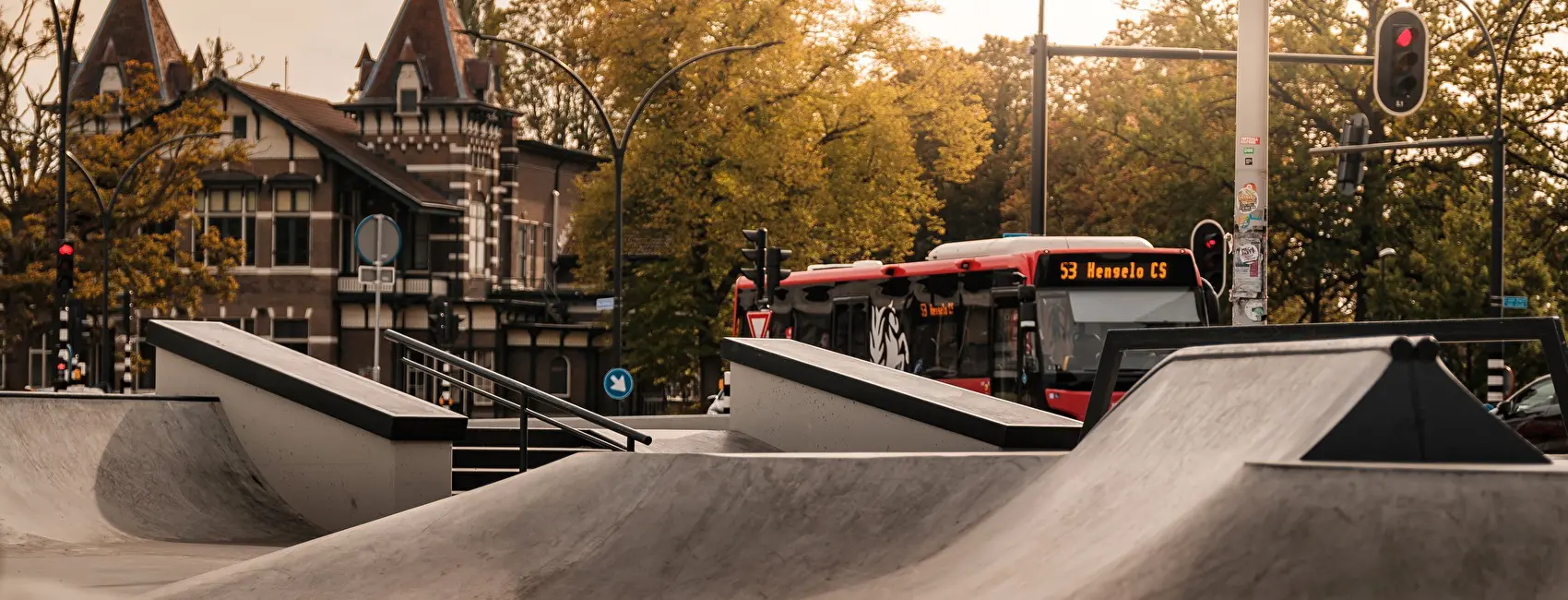
Urban sports take a holistic approach, and it makes sense for municipalities to do the same. So opt for broad collaboration within the municipality. Then you can really use urban sports to create opportunities for young people. Through urban sports you can bring 'moving in a different way' into your municipality. For example as an aspect of public space planning: when you redesign a central square, people from the scene, who understand the target group and know how to build spaces for movement, can help think about how to include creative movement and urban sports in a design. Just like at Hengelo station, for example.
Urban sports offer municipalities many ways to create opportunities for young people and to get them moving and keep them moving. They add value to the livability of a municipality. Above all, just get started and put the target group at the center. Really do it together with them and leave room for experimentation. Dare to think of movement more broadly and approach it from other sectors.
Maxi Sellering
Head of International Relations & Development at 3X3 UNITES
